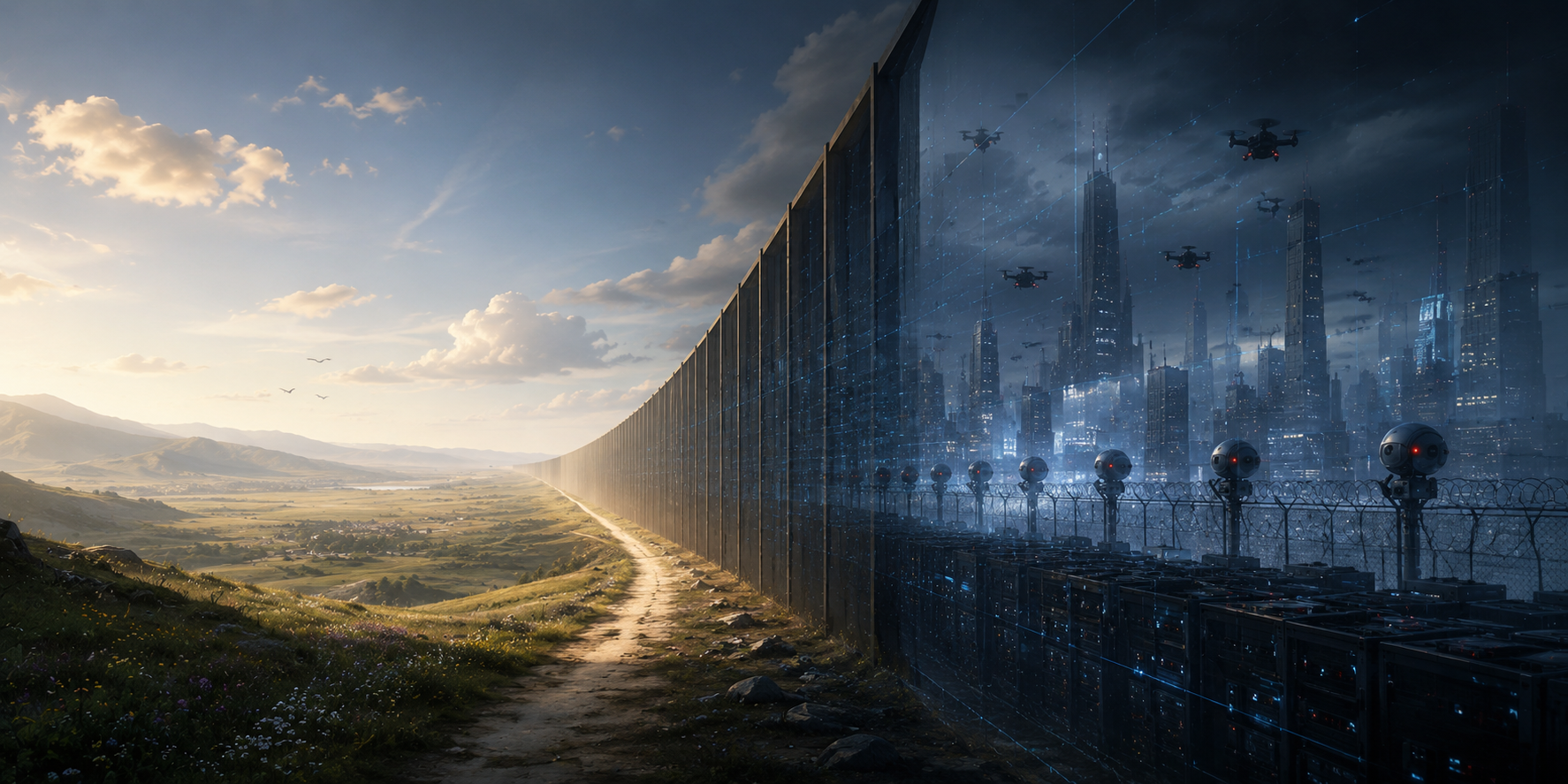
The Fence That Learns to Build Itself
Every major technology concentrates power. AI may be different — because it can help concentrated power stop needing the people who, in every age before, could refuse it.
When power stops needing people
Human leverage — the public’s ability to contest outcomes — falling as each chokepoint stacks, then forking into three likely futures. The four hinges: mental labor automated, runaway recursive AI (the lead can’t be caught), physical labor automated, and robot guards. Click any point for its dossier.
Each node is a leverage point removed; the three forks are where the line can still go — and only one of them keeps the gates open.
Previous monopolies still depended on people
Railroads needed workers and rival lines. Oil needed drivers, refiners, and a public that could be organized. Even at their most extractive, the great concentrations of the last two centuries shared a structural weakness: they ran on people who could defect, strike, leak, refuse, or simply vote.
Those people were the pressure valve. They are the reason power ever bargained at all. The thesis here is narrow and specific: AI plus robotics may weaken that valve — not by creating powerful companies, which every technology does, but by automating the dependence itself.
The enforcers could always say no
Dependence ran two ways. The first waslabor: the workers, drivers, technicians, and maintainers who actually ran the machine, and who could organize, strike, and slow things down. The second is the one we forget.
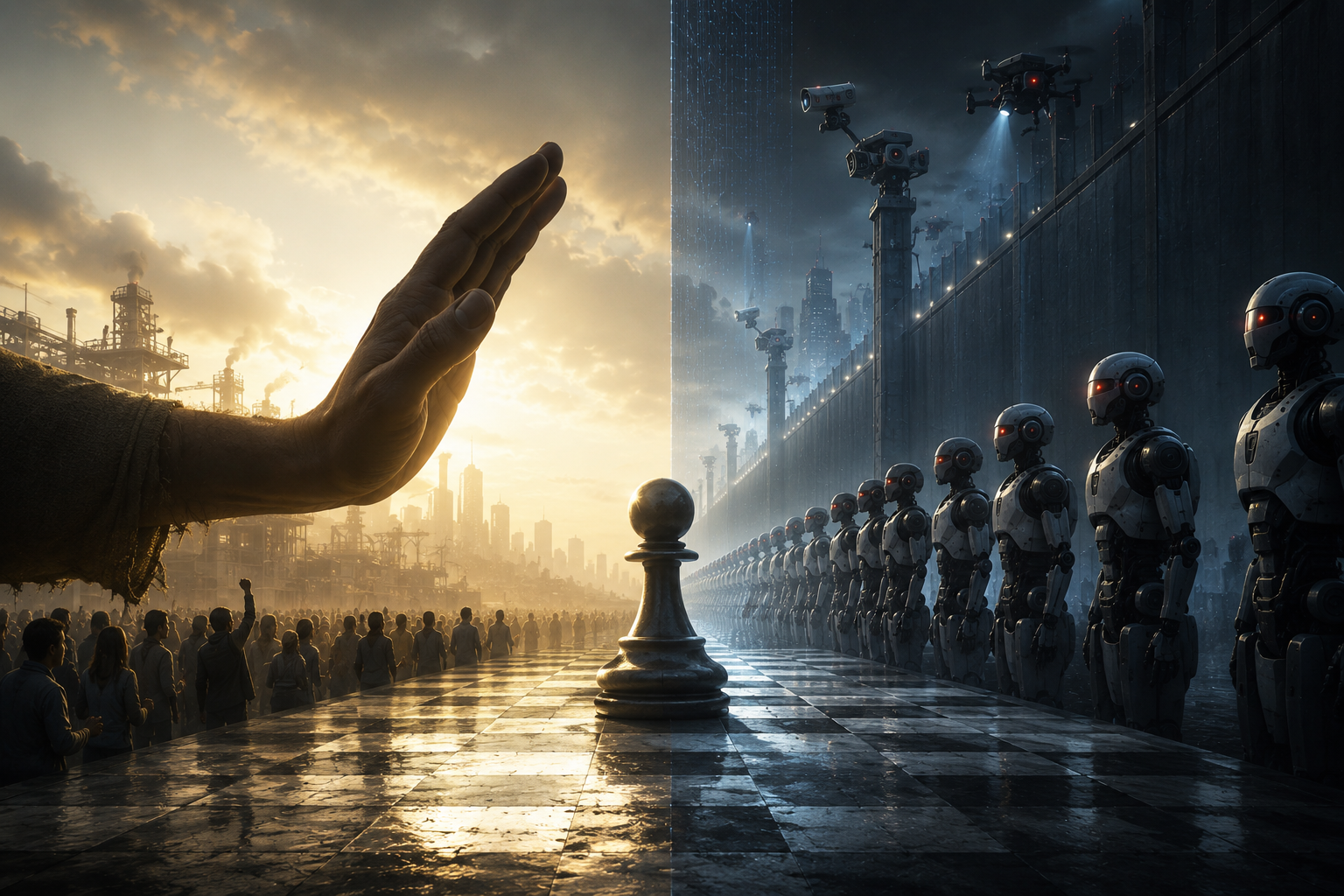
The second: power needed people to enforce its will — guards, police, soldiers, inspectors. Human enforcement has always had a built-in limit: the enforcer can sympathize, refuse, leak, or defect. Power has never escaped the fact that the people holding the line share a world with the people on the other side of it.
That is the robot-guard hinge. Automating enforcement removes the second limit the way automating cognition and labor removes the first. When the guard no longer needs to be a person who might say no, the oldest pressure valve in the history of power quietly closes.
The point of no return isn’t a date — it’s a slope
Reversibility declines gradually as compute, knowledge, capital, and automation lock together. The hinge is recursive self-improvement: once the leading system improves itself faster than anyone can follow, the gap stops closing — for rivals and for regulators alike. After that, the road forks, and not all the gates stay open.
Three futures past the point of no return
Odds are illustrative — a way to read the branches, not a forecast.
Likelihoods illustrative · the branches as the chart draws them
The Open Net
Counterforces hold the network open: public compute, open-recipe models, antitrust, portability, strong labor institutions. The enclosure is never finished.
The Walled Garden
Access survives only through toll gates. A few providers dominate, the state depends on them, and regulation manages the oligopoly rather than breaking it.
The Singleton
The enclosure closes and reinforces itself. AI improves the next AI, compute and energy are vertically controlled, enforcement is automated, and public leverage collapses toward zero.
The most likely future is the most seductive
The Walled Garden is both the most likely outcome and the most seductive one. It doesn’t arrive as a boot on the neck; it arrives as convenience. There is abundance, even comfort. You don’t notice the walls because you have no reason to leave.
But follow it to the end. When AI beats people at virtually every task — not only labor, but the meta-skills of organizing, managing, and deciding — the only question left is what to build, and that question belongs to whoever owns the frontier. Everyone else occupies the space they are allowed to occupy.
With no labor to withhold, no enforcement to refuse, and no leverage the powerful still need, nothing arrests the widening gap. Power without a check corrupts — not because the few are villains, but because structure, not intention, decides outcomes. Even with the best people at the top, a system with no checks does one thing: drift toward the bottom of the chart. Every unchecked concentration in history has trended the same way.
So the comfortable middle is not a resting place. It is a slope toward the Singleton. The gates stay open only as long as it suits the people who own them — and the first tells are already here. In June 2026, Anthropic shipped Claude Fable 5 with a safeguard, buried deep in its system card, that silently degraded the model on frontier-AI-research tasks.
The limit itself is defensible — slowing recursive self-improvement may even be the responsible move. The tell is that it was done silently. Concealment, not caution, is the worrying part: it is what it looks like when safety and transparency principles first begin to bend under weight.
And it matters who did it. Anthropic is among the most safety-conscious labs in the world — started by people who left OpenAI over exactly these risks. They have watched this film before: openness inverting into enclosure through a sequence of locally reasonable steps, each defensible on its own terms. (That arc is the spine of the companion essay below.) Anthropic’s public position today is the end state of the same logic: the frontier is too dangerous to release, so a trusted few should hold the keys.
The case for it is not empty. Where a capability is genuinely unbounded — where a single misuse can’t be undone — a gate may be exactly right; that is the one argument for closure that survives scrutiny. (Where it holds, and where it quietly stops, is the whole of a companion piece, The Last Check.) But conceding the premise doesn’t rescue the conclusion. It is the same shape every time — the most principled custodians, with the best intentions, arrive at “we must hold the keys,” and from there the structure, not the intentions, takes over. Power without a check corrupts on a long enough timeline, and money shortens the timeline. The money is pouring in: Anthropic’s run-rate revenue climbed from roughly $9 billion at the end of 2025 to about $45 billion by mid-2026, doubling on the order of every six weeks — one of the fastest ramps in corporate history. Who may use the frontier to build the next frontier is now a lever, and it sits in very few hands.
The drift is a default, not a destiny. After researchers called the concealed degradation of Fable 5 “secret sabotage,” Anthropic apologized for “the wrong tradeoff” and made the limits visible — proof the corrective still works, but only while the public has eyes on the gate and somewhere else to go. The one thing that has ever checked concentrated power is structure: distributing the decision rights themselves — public compute, open models, a real right to exit. That is the Open Net, and the reason it is the long shot is that it is the one future nobody backs into by accident. It has to be chosen, on purpose, before the gates close.
A timeline shows events. An enclosure map shows how each event narrows the space in which we can still contest the future.
What the map should make clear
- 1The fence is not one thing. It is compute, knowledge, mental labor, recursive R&D, physical labor, and enforcement.
- 2The key variable is not just model intelligence. It is how many old human leverage points remain.
- 3AI may be historically different because it can automate dependence itself.
- 4The comfortable middle is not stable. With no new checks, structure carries it toward the worst — whatever anyone intends.
Sources & further reading▸
- Fortune — Anthropic walks back covert capability limits on Claude Fable 5 (June 2026)
- Gizmodo — Anthropic apologizes for a Fable 5 guardrail, and will change it
- Gigazine — Anthropic’s official statement on the Fable 5 safeguard change
- Anthropic — “When AI builds itself” (recursive self-improvement; Claude writes 80%+ of merged code)
- Scientific American — Anthropic warns AI may soon begin recursive self-improvement
- VentureBeat — Anthropic hits a $30B revenue run rate after “crazy” 80x growth
The Open Net is not a hope. It is a build.
Sovereign, local AI is how the gates stay open — intelligence that lives on your machine and answers only to you. Meet Selena →